
Office · Commercial research
Government and Professional Services Office Cleaning
What government and professional services offices need from a cleaning contract — accountability, vetted staff, defined scope, and the documentation that stands up to scrutiny.
5 min read
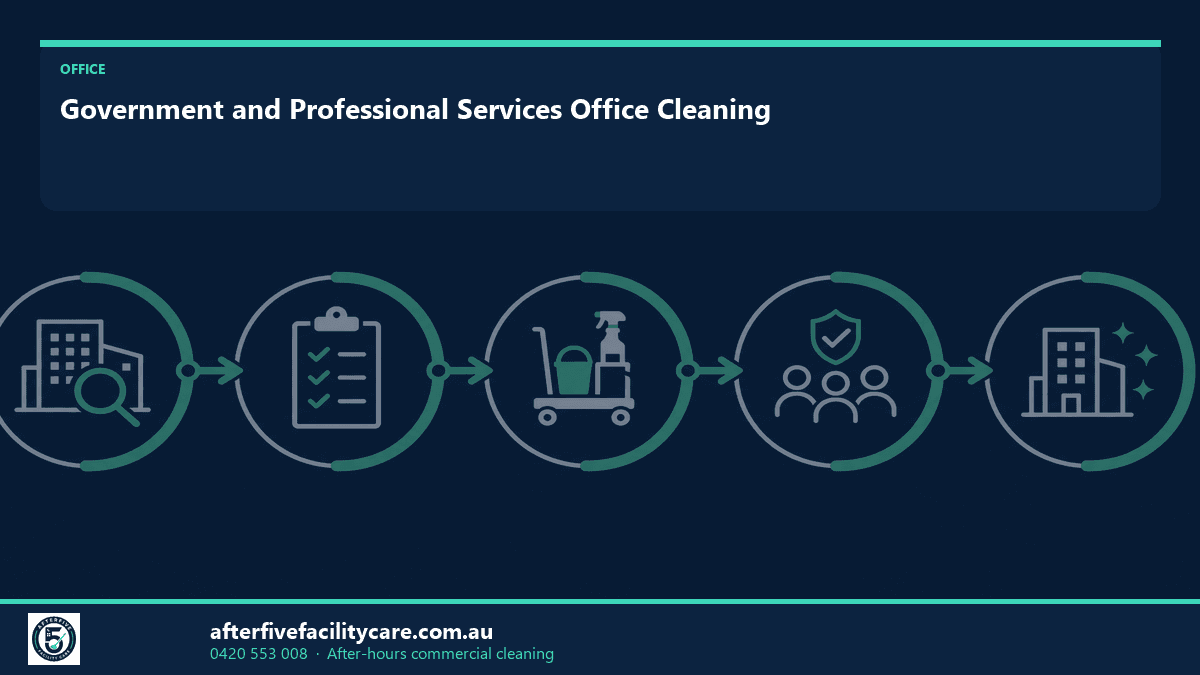
Choosing a cleaner for a government office or a professional services organisation is less about finding the best clean and more about finding the most accountable one. These offices operate under scrutiny — public accountability, professional obligations, procurement rules, and an expectation that every arrangement can be justified and reviewed. The cleaning contract is a small part of that world, but it is subject to the same standards: who is on the premises, what they do, and whether it can be documented. This guide covers what these offices should require from a cleaning provider.
Accountability is the defining requirement
A private business can choose a cleaner on price and a handshake and change its mind next month. A government office or a regulated professional services organisation cannot operate that loosely. It answers to auditors, oversight bodies, procurement frameworks, and public expectation. Every supplier relationship, including cleaning, is expected to be defensible: chosen on clear criteria, delivered to a defined standard, and documented well enough to review after the fact.
That reframes the whole decision. Presentation and hygiene still matter — these offices are often public-facing and hold themselves to a professional standard — but the distinguishing requirement is accountability. The contract has to be built so that if anyone asks who was in the building, what was cleaned, whether staff were vetted, and whether the standard was met, there are clear answers on record. A provider who cannot supply that structure is a poor fit regardless of how well they clean.
Vetted staff and controlled access
The most sensitive element is who gets access to the premises. Government and professional services offices hold information and occupy spaces where uncontrolled access is unacceptable. The cleaning contract must rest on staff who are properly vetted and police-checked, working a stable roster so access is confined to a known, accountable group rather than an anonymous stream of casual labour.
Controlled access is not just about vetting the people; it is about managing the mechanics — inductions, key or fob control, alarm procedures, and a record of who was on site and when. After-hours cleaning fits these offices well because it confines cleaning access to a defined window when the working day is over, keeps public and working areas presentable during hours, and makes access easy to control and log. When you evaluate providers, ask precisely how they vet staff, whether the same team services the site, and how they manage and record access. Vague answers signal a provider who has not worked under this kind of scrutiny.
A defined, documented scope
Accountability depends on a scope that is written, specific, and reviewable. "Keep the offices clean" cannot be audited. A defined scope that names each zone, states what is done, and states how often gives everyone — the office, the provider, and any reviewer — a single, agreed definition of the service.
| Element | What it provides | Why it matters for accountability |
|---|---|---|
| Written zone-by-zone scope | Clear definition of the service | Auditable; removes ambiguity |
| Frequency schedule | Defined rhythm per zone | Confirms the office gets what it pays for |
| Staff vetting records | Evidence of who has access | Defensible under scrutiny |
| Access and attendance log | Record of site access | Answers "who was here, when" |
| Inspection and reporting | Evidence the standard was met | Supports review and continuous improvement |
The table shows why documentation is not bureaucracy for its own sake in this context — each element answers a question these offices can reasonably be asked. A fixed written scope also protects the budget, because the office is paying for a defined result rather than an open-ended arrangement that is hard to justify.
Reliable delivery, not heroics
Government and professional services offices value reliability over flourish. The standard needs to be met consistently, week after week, without drama — because inconsistency is exactly what invites complaints and scrutiny. A provider that delivers a brilliant clean sporadically is worse for these offices than one that delivers a solid, defined standard reliably.
Consistency comes from the same mechanisms that support accountability. A stable, vetted team learns the site and takes ownership. A written scope gives the crew a checklist. Scheduled inspections against the scope catch drift early and generate the evidence that the standard is being met. A clear escalation path means that when something is missed, there is a named way to raise it and a documented resolution. Together these turn cleaning from a hopeful arrangement into a managed, reviewable service.
Presentation for public-facing offices
Many government and professional services offices are public-facing — service counters, waiting areas, meeting rooms where citizens or clients are received. These carry a presentation standard that reflects on the institution. A shabby public counter or a neglected waiting area sends a poor message about how the organisation is run, and in the public sector that message carries weight.
So the scope has to hold the front-of-house areas to a high, consistent standard alongside the working floors and amenities. This is not in tension with the accountability requirements — it is part of the same discipline. The zones the public sees are named in the scope, cleaned every visit, and included in the inspections, so their standard is as documented and reliable as everything else.
Scoping your contract
Before going to market, map your premises against the requirements these offices face. Identify the public-facing zones, the working areas, the amenities, and any spaces with access sensitivities. Decide what documentation you need — scope, vetting records, access logs, inspection reports — so the contract can stand up to review. That map becomes the basis of a scope built for accountability, not just cleanliness.
Then require any provider to quote against that scope after a walkthrough, and press them on vetting, access control, and reporting as hard as you press on the clean itself. The right partner for a government or professional services office talks fluently about documentation, vetted staff, and reliable delivery, because they have worked under scrutiny before.
AfterFive builds a defined, documented office cleaning scope with vetted staff and clear reporting suited to accountable organisations, and we service government and professional services offices across Melbourne's west. To put an accountable standard in place, request a walkthrough and we will scope it to your premises.
FAQs
What do government and professional services offices need from a cleaner?
They need accountability above all: vetted staff, a clearly defined and documented scope, reliable delivery, and records that stand up to scrutiny. Presentation and hygiene matter, but the defining requirement is a contract that can be audited and relied upon.
Why is documentation important for government office cleaning?
Public-sector and professional bodies are accountable for how they spend and who accesses their premises. A documented scope, staff vetting records, and clear reporting make the cleaning contract defensible and easy to review.
Should government office cleaning be done after hours?
After-hours cleaning suits most government and professional services offices because it keeps public-facing and working areas presentable during the day and confines access to a controlled, accountable window.